

INN recognizes higher education in prison as a profound incubator of lived-experience leadership and thus structural change. Countless people who benefit from such programs go on to become justice leaders whose impact has a ripple effect on their communities, countries and the world.
For that reason, INN is deeply committed to the mantra “Education Not Incarceration.” The phrase denotes two things: 1. Education, particularly higher education, is perhaps the most tremendous tool available for radically shifting prison paradigms from punitive to genuinely rehabilitative, anywhere in the world; and 2. Given that most people in prison, globally speaking, are the have-nots of society—the ones who, especially on account of race, class or gender, have been denied access to social opportunities—had incarcerated people been offered education in the first place, they probably would not be facing incarceration. After all, even in countries where state entities are challenged, there is always a functional university—worth tapping into as a matrix of services, opportunities and potent networks for incarcerated and formerly incarcerated individuals.
“Education Not Incarceration” underpins two areas of INN’s work:
(1) The Global Freedom Scholars Network, the world’s first transnational network of justice-involved students who are advocates for higher education in prisons worldwide, building a new global norm in which access to higher education in prisons is not a radical notion but an expected one. The GFS Network has chapters in the UK, Italy, Argentina, Brazil, Nigeria, South Africa, Kenya, Trinidad & Tobago, Jamaica, Ghana, Uruguay, Chile, Colombia, Spain, Australia, Canada and New Zealand. Annual regional and global events keep the Global Freedom Scholars connected and collaborating, as does a web platform; all Chapters are supported in myriad activities in their home countries that, broadly speaking, promote Education Not Incarceration and advance community for incarcerated and formerly incarcerated university students and graduates. Such activities include engaging with policymakers, mentorship programs, tutoring networks, scholarship support, working with young people from underserved communities and building new prison university partnerships.
(2) Support for prison-university partnerships, both existing and new, leveraging the power of education to change and nurture leaders with lived experience. Some of these programs fall under the umbrella of the Prison-to-College Pipeline (P2CP), which Dr. Baz founded at New York’s John Jay College of Criminal Justice in 2010. Not a cut-and-paste model but a philosophy that manifests uniquely in various global contexts, the international P2CP movement has two premises: 1. Universities have a powerful and apolitical role to play in creating safer communities; and 2. All educational programs that operate inside prisons must be continued on the outside, when incarcerated people come home from prison—hence the concept of the “pipeline,” a continuum.
INN has given birth to four global Prison-to-College Pipeline initiatives (in Jamaica, South Africa and Trinidad) and supported/consulted on more than a dozen existing or burgeoning ones worldwide.
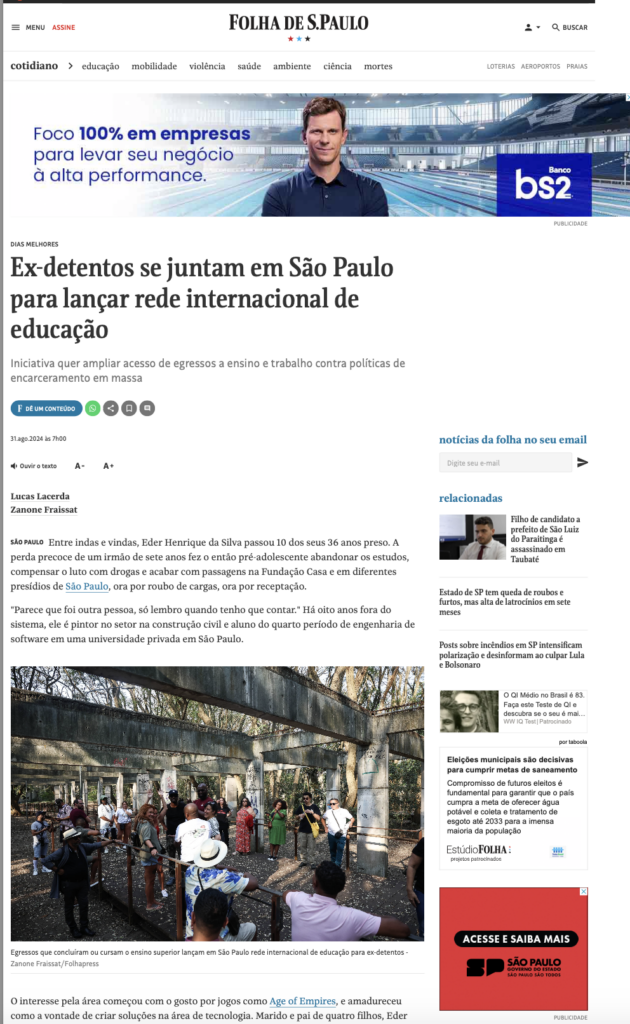
The Launch of Global Freedom Scholars Network in São Paulo, Brazil, in August 2024:
